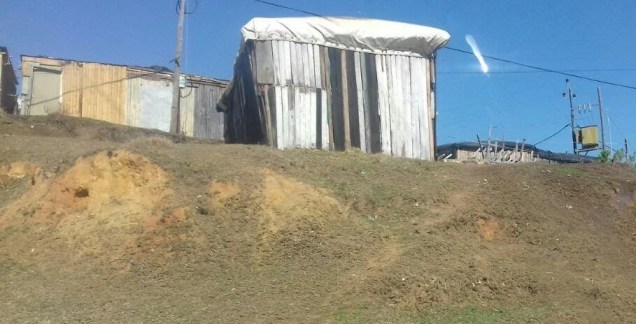
Almost … but not quite.

“Loneliness and the feeling of being unwanted is the most terrible poverty.” – Mother Teresa

Have you ever experienced the “Almost … but not quite”?  You almost made the team, but not quite.  You almost got into the Honor Society, but not quite.  You almost crossed the finish line first, but not quite.  You almost passed the test, but not quite.  We can all think of times we had an  “almost … but not quite” scenario.  We wanted something so badly, but we just missed the mark.

It is a frustrating, disappointing and heartbreaking place to be.

Now imagine being almost part of a family, but not quite.  Feeling unwanted.  Given a place to live out of obligation.  Sitting on the fringes of the family circle.  Nobody rejoicing in your successes.  Nobody helping bear the burden of your hurts and disappointments.  You are just the niece.  Just the cousin.  Just another mouth to feed.  Just a burden.

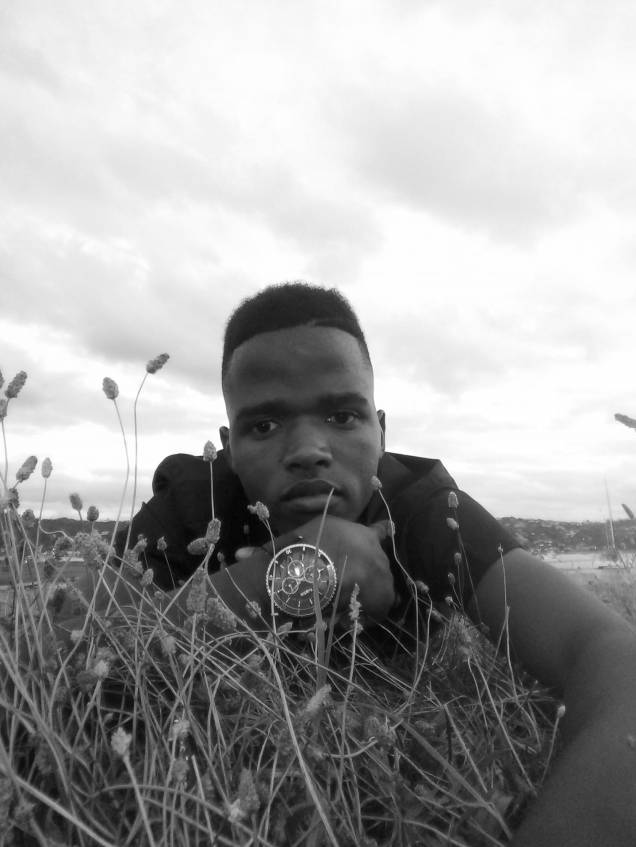
Ntsibeng Shete is a  21-year old Sotho girl whom I met 2 years ago (January 2017).  At that time, she was in her metric (senior) year at Concordia High School in the Knysna Township with her hopes set on attending university.  She and I worked together after school navigating through Life Science.

(Side Note: Sotho /su:tu is one of many tribes in South Africa.  The sotho people speak a language called Sesotho.  It is one of the eleven official languages of South Africa.  This is Ntsibeng’s native tongue.  She now speaks Sesotho, Isixhosa and English).

20190124_110553
Ntsibeng

Born in 1997 in the Mtata Township on the Eastern Cape, Ntsibeng’s life began with tragedy.  She almost had a dad in her life, but not quite.  Two weeks after she was born, her father died of complications from diabetes.  She would never get to know a father’s love.

Instead, her family would be all women… Ntsibeng, mom and grandma.   A common family unit in South Africa’s Townships.   Absent dads.  Present grandmothers. 

This could and should work.  It did for six years.  Then Ntsibeng’s mom grew restless and decided it was time to make a change.  So she did.  She moved several hours away to the Western Cape and left Ntsibeng behind.  Yes, she left her 6-year old daughter behind.  Ntsibeng felt abandoned.

For the next four years, Ntsibeng lived alone with her grandma.  Although she longed for her mom to return, Ntsibeng loved her grandma dearly.  “She was my everything”, she said with a big smile on her face. 

Little did this young girl know how drastically her life was about to change in 2007.  She was 10-years old and excited that her mom decided to return from the Western Cape.  What she didn’t know was that her mom was very ill.  She had contracted HIV and TB while away.  She had also given birth to a son who Nsibeng knew nothing about.  A 4-year old little brother.

As she began to process these new life changes, the return of her mom and the introduction of a younger brother, Ntsibeng’s grandma was diagnosed with and died of breast cancer.  2007 proved to be a very emotional year for such a young girl.  A roller coaster of emotions.  Heartbreak in the loss of her grandmother.  Joy in the return of her mom and new brother.  Ntsibeng was still so young.  She believed things would be OK.  They would begin to live as a new family unit.

Or would they?  “Almost … but not quite.”

In July of 2008, only one year later, her mom got worse.  Ntsibeng, 11-years old at the time, remembers her mom telling her to go find someone to help.  She ran out of the house to find a neighbor, but when she returned, her mom had already passed away.  Ntsibeng honestly believes that her mom sent her away so that she would not watch her die.  One final act of love from a mom with whom she had spent so little time.  A relationship almost mended, but not quite.

Funerals are expensive.  Especially to those living in poverty.  To pay for these expenses, the relatives had to sell the grandmother’s house. This in turn left an 11-year old girl and 6-year old boy with no place to live.  What would happen next?  The decision was made to separate the sibliings.  Baxolele (her brother) would remain in the Eastern Cape and live with his grandmother’s sister.  Ntsibeng would be sent to the Western Cape to live with her mom’s brother and his wife.

With so much chaos, turmoil and uprooting in her life, Ntsibeng missed a lot of school.  She arrived in Knysna in 2009, and almost passed grade 4, but not quite.  She would have to repeat.

The years moved along. Life in her uncle’s home was hard.  His wife refused to accept Ntsibeng as “their” child.  They had their own children.  Ntsibeng was just the niece.   A “Cinderella” life style ensued.  Ntsibeng felt like the unwanted outsider.   Made to do all of the chores while her cousins played.  Foster care money was received, but not spent on Ntsibeng.  She still remembers having no clothes that fit.  “When I moved up to High School (grade 8), I still had to wear the primary school uniform for quite some time,” she said sadly.   It was embarrassing for her.

Finally in 2014, when entering grade 9, Ntsibeng was able to convince her mom’s sister to allow her to live with her family in the same township in Knysna.  Baxolele joined her there (from the Eastern Cape), filling the 2-bedroom concrete block home with 9 people.  Ntsibeng and Baxolele were sent to sleep outside in a wooden shack with no water or electricity.  Unfortunately, the same “Cinderella” life style began to unfold for her.  After all, she was once again, just the niece.  Her aunt and uncle had many of their own children to care for.

Ntsibeng watched her cousins participate in  extra curricular activities, but to her, the answer was always “No, we don’t have enough money.”   It was made clear from the start of her matric year, that they would only support their daughter to University.

Ntsibeng started to flounder.  What would she do now?  She wanted to continue her education,  but was not accepted into University for 2018.  Her marks were almost high enough, but not quite.  She knew she had to rewrite two of her courses in order to apply again for 2019.

Since that would be at the end of 2018, she decided to get a job to get her through the year.  She saw an ad for a job at the hospital at the information desk.  She applied, interviewed and got the job. 
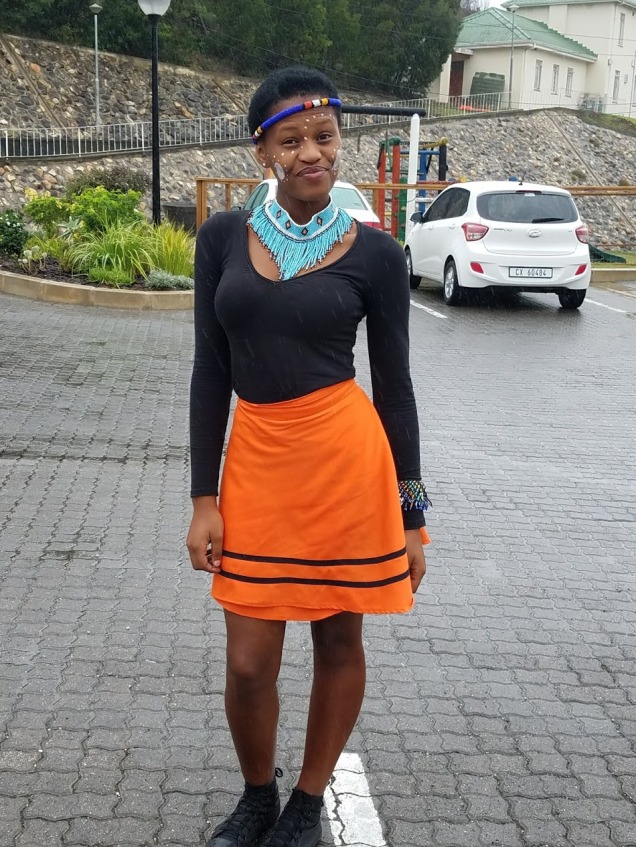
20180315_080804
Ntsibeng dressed for a job interview.

Ntsibeng struggles with feeling loved by family.  Although she was fortunate that relatives allowed her to stay with them over the years, she never felt as though she was looked at as “their” daughter.  Instead, she was always an outsider.  Almost part of each family, but not quite.

This year, Ntsibeng was accepted to the University of Fort Hare in the Eastern Cape.   She almost started her college career, but not quite.  She panicked.  She had never been to see the University.  She knew she would have to look for accommodations.  She had nobody to counsel her or willing to go with her to sort things out.  She could not get herself to make the 6-1/2 hour trek there with so much uncertainty.  So, she didn’t go.  A missed opportunity.  A setback for another year.

Ntsibeng is a sweet girl.  She continues to bounce back from life’s disappointments.  This week she has applied to and is training for a server job in a restaurant.   She knows that her aunt and uncle want her out.  If she lands this job, she just may be able to rent a shack of her own.

Hopefully next year, 2020, Ntsibeng will be a University Student.  She does not need another  “almost … but not quite” year!
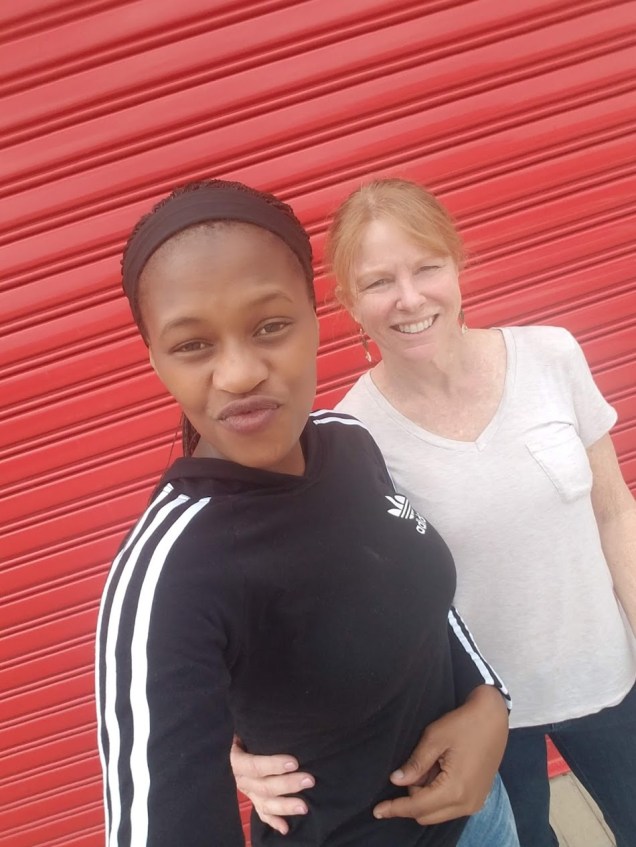
20190124_110525
Ntsibeng and Tracy

“C”ooking Good!

“Keep your heart open to dreams. For as long as there’s a dream, there is hope, and as long as there is hope, there is joy in living.” ~ Author Unknown

Dreams.  We all begin dreaming of our future at a very young age.  Preschoolers proudly proclaim their future occupation at their graduation ceremony…  Fire Fighter, Doctor, Vet, Super Hero and Princess to name a few.  They believe they can be whatever they want to be.

My new friend Siphenkosi Sihono also has a dream — to be a chef.  “I really enjoy cooking,” the 24-year old told me over a hamburger the other day.

0

But unlike many of us, dreaming of a future was not something Siphe (pronounced See-pay) did as a youngster.  With so many obstacles and failures in his life, why dare to dream?

Born in the Eastern Cape of South Africa in a village outside of Mount Frere, Siphe’s mom relinquished him to his grandmother’s care, immediately after his birth.  “Why?”, you may ask.  She was married at the time… but not to her baby boy’s father.  She knew her husband would never accept him nor allow her son to grow up in their household.

And so began his life …  Siphe would grow up in his grandmother’s wooden home with no running water and no electricity.  He became part of a household where 9 other cousins were already living.  A very poor family where enough food was often a challenge.

But when asked how his life was growing up, Siphe responded, “My Gogo (grandmother) is a good woman.”  His grandmother made them a family.  She gave them a place to live and provided what little she could.  He was happy.

(Side Note… Mount Frere is a very small, underdeveloped town in the Eastern Cape.  The closest residents to the town live in rural villages ruled by Tribal Chiefs.  These villages are still lacking basic services like proper roads, electricity and water.  River water is still used by many who don’t have water tanks to collect their water.)

Throughout the years, Siphe’s mom would visit him when she could.  His father did not.  He had no contact with his dad until he was 16-years old.  

None the less, life went on… Siphe attended the only primary school in the village where the education was very poor.  When he started High School, the only school around was 5 kilometers away.  With no transportation available,  he hiked to and from school each day.  There he attended but failed to pass Grade 9.

It was then that Siphe learned that his father, was moving to Knysna with his wife.  Knowing that the schools were better in the Western Cape, Siphe asked if he could move with them.  He pleaded his case for a better education.  Surprisingly, his father and his wife agreed.

In 2013, Siphe moved to the Knysna township with his dad and stepmom.  They rented a wooden shack with no electricity and no running water.   Siphe didn’t complain.  He was used to that way of life.  This was his chance to get a better education.  This was going to be the turning point in this 18-year old’s life.  He was starting a new school in a new town.

Throughout the school year, things in his household deteriorated.  His dad was drinking.  The yelling started.  His stepmom left. The turmoil took a toll on Siphe.  His studies suffered.  He failed grade 9 again. 

Siphe was now 19-years old, with no hope of finishing High School.  His dad had given up on him and insisted he get a job.

His goal to finish school, had become unachievable.  This only confirmed why you do NOT dare to dream!

As he walked around town handing out his CV (resume), a woman took notice.  She was the manager at the grocery store and saw that he was 19-years old and had not yet completed and passed grade 9.  Unacceptable.  This boy must be in school.  She contacted our friend Ella to see if she could help. 

Ella and her business partner Penny met with Siphe and gently encouraged him to move into Ella’s Safe House and return to school.  Siphe took them up on the offer and moved into the Lukhanyiso Safe House.  So, at 19-years old, Siphe would attend Grade 9 again at a different high school in the same Knysna township.  Would the third time be the charm?

Yes!  He passed grade 9 with a bit of struggle.  But he passed!  And it was now time for this 20-year old to have some privacy and be a little more independent.  He was so much older than the other children in the Safe House, so Ella moved Siphe into a wooden house on property her mother owned.   Due to a dispute over the land, Siphe’s new shack became a target.  It was burned to the ground with the few things he owned.

Time to give up?  Throw in the towel?  He was struggling with his grades so much, that even Ella recommended he leave school in grade 10 and learn a trade. 

Siphe wasn’t ready to give up.   He was determined to achieve his goal.  And he did.  He successfully completed and passed, not only grade 10, but 11 and 12!  He matriculated (graduated) from high school at age 22.

As I spoke with Siphe and to others about him, it is obvious he has never been one to get into trouble.  He is very respectful and endearing with a squeaky clean reputation.  He put his nose to the grindstone, stayed out of trouble and accomplished his goal of finishing high school.

Siphe now dares to dream of a future.  He wants to be a chef!  He envisions himself working as a chef on a cruise line or in a hotel.   When asked if he had ever been on a boat, his answer was “No, never.”  Hmmm, I think he may want to go on a boat ride before accepting any jobs on the water!

Working toward his new dream, Siphe, with financial support from the Khayamandi Foundation, is currently attending South Cape College in Oudtshoorn, South Africa.  He is beginning Year 2 of a 3-year program where he will earn a diploma in Hospitality and Catering.  His classes include Catering Theory, Applied Management, Safety and Sanitation, and Nutrition and Menu Planning.  As part of the program he must complete practicals where he works in the industry.

Siphe has to work hard to succeed.  Schooling does not come easy to him.  But he is determined to succeed and is willing to put in the work.  He now knows he can accomplish his goals and dare to dream of a future!  

siphe 4

Opening Their Hearts and Home

“It’s not the size of your house that makes a home… It’s the size of your heart.” ~Jane Lee Logan

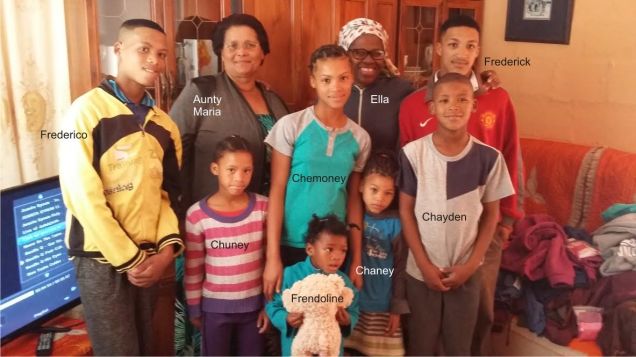
In June 2017, Maria and her husband Freddy opened their hearts and home, doubling the size of their family overnight.  They have six children of their own.  Yet in June, they agreed to take in six of Maria’s cousin’s children who became orphaned.

unnamed-6
The orphaned siblings with Maria and Ella. Frederick, the oldest did not move to Knysna.

Maria grew up in the Eastern Cape of South Africa.  At the age of 20 years old, she had her first daughter with a man to whom she was not married.  Then 3 years later, she had her second daughter.  Maria is a strong woman and began raising these girls on her own.

At the age of 26, she met Freddy, the man of her dreams.  They fell in love and were married.  They just celebrated their 26th wedding anniversary!  Freddy is a good man.  He has always worked hard to take care of Maria and their children.  For years, the only work he could find was in Knysna, two hours away from his family.  He moved there to work and traveled home when he could to see his family.  This is so typical of families.  If the father is still involved with the family, he may have to live in another town to work, only seeing his family on occasion.  

While he worked in Knysna, Freddy stayed with Maria’s sister.  She lived in an area of the township that was very underdeveloped at the time.  No roads.  No concrete block homes.  No water.  No electricity.  This was now Freddy’s home away from home.  He would work all day long and often help neighbors at night and on the weekends.  He is a handy man.  Someone who can fix almost anything.  And he is always willing to help.  One neighbor took notice of his kindness to the community.  She starting talking with him about his work, his family and his plans.  She wanted to know if he planned to move his family to Knysna.

Of course Freddy would love to do that, but where would they live?  He and his wife had six children!  The woman was full of compassion.  She told Freddy that she wanted to give her land to him so that he could move his family to Knysna.   A piece of land full of brush and vegetation.  No buildings.  So much potential.  Wow. 

Freddy couldn’t wait to tell Maria.  But she held back her excitement.   She had concerns.  She didn’t know this woman.  What if they accepted the offer, built a home on the property, and then the woman turned around and took the land back.  Valid concern.

Freddy returned to Knysna a few days later and addressed Maria’s concern with the woman.  She so wanted to give them this gift.  She insisted Freddy go with her to the magistrate where she signed the land over to him.  It was now legal.  No strings attached.  A priceless gift.  Maria and I both agree… a true blessing from God.

Freddy got to work building his family a wooden house.  Actually one that feels large inside because he designed it with high ceilings.  When it was finished, the 8 of them moved in.   The home had a kitchen and two bedrooms.  No bathroom.

unnamed-5
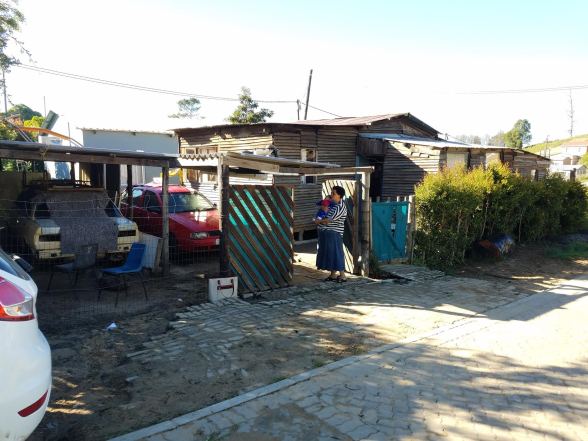
Maria standing in front of the Wooden home Freddy built 13 years ago. The blue RDP house is in the back.

Life was good.  Not easy.  But good.  They were surrounded by bush.  No roads.  No running water.  No electricity.  No sanitation.  But they were all together again!  Within a couple of years, that part of the township (Dam Se Bos) began to develop.  The government brought roads, water lines, sanitation and electricity to that area.  RDP homes (Reconstruction and Development Programme) were being built.  A few years ago, Maria and Freddy qualified for their small government home (2 bedrooms / 1 bathroom).  This now stands directly behind the wooden house.

Side note:  The RDP program was initiated by the ANC Party under the leadership of Nelson Mandela.  Poverty is the single greatest burden of South Africa’s people, and is the direct result of the apartheid.  As part of this program, people in poverty have the opportunity to receive a free home.  Those eligible must meet these qualifications:  Must be a South African citizen; over the age of 21; married or living with a partner OR single with dependants; earn less than R3,500 ($295 U.S.) per household per month.  The problem is that it can take years before your home is built.  I know some people that have been waiting 15-20 years.

This brings us to June 2017.  Maria got a call from family members telling her that her cousin had been murdered.   She was stabbed in front of her home, in front of her children.  She was an alcoholic and apparently got into an altercation with another woman, leading to her death.  Six children were now orphaned.  Their mother was dead and their alcoholic father had been murdered (stabbed) a year earlier.  It is so hard to imagine what these children went through in that household.

Maria, who didn’t really even know the children, was begged by relatives to take them in.  If Maria did not take them, they would be separated and put into foster care.  She did what came naturally.  She prayed.

Maria felt God tugging on her heart.  She must give these orphans a chance.  So off she and Freddy went to pick up 6 more children to join their family.

unnamed
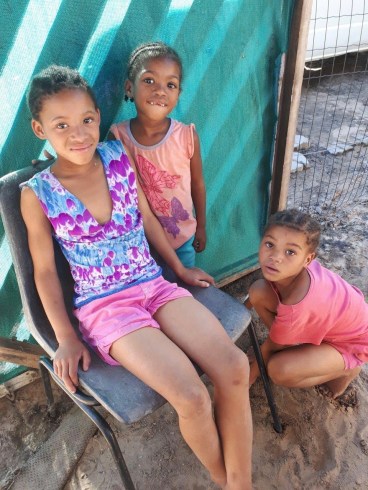
The youngest sisters recently orphaned.

Maria’s two oldest daughters had already moved away.  One lives in Capetown and one lives in Johannesburg.  However, they each have one child a 4-year old girl and a 2-year old boy that live with Maria and Freddy.

If you are trying to keep a head count, here it is… In the household resides: Freddy, Maria, 4 of their children (3 in high school and a 25-year old who just had a baby), 3 grandchildren and 6 of her cousin’s children.  A total of 15 people.  4 bedrooms.  1 bathroom.  Yes, 1 bathroom.  Things are a little crowded, to say the least.


Not only that, the financial struggle is very real.  Freddy has a maintenance job (actually in the neighborhood where we rent a house).  He works hard all week long and then pastors a church in his community on Sundays.  I don’t know Freddy’s salary, but it would be typical for him to make around $17 U.S. per day.  He is the only bread-winner in the home.

Praise God my friends Penny and Ella (Emzini Tours), who I mentioned in the blog posts “Unprotected-Part 1” and “Unprotected – Part 2”, have partnered with Freddy and Maria to help provide for the orphans.  They pay for school uniforms, transport to school, school fees and some food expenses.  It is a necessary blessing for the family.

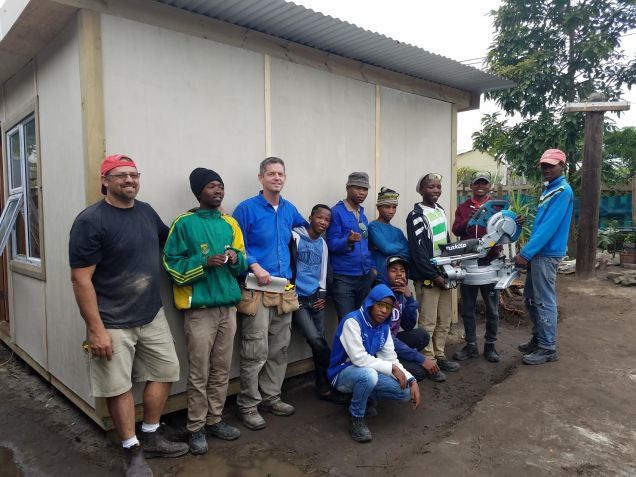
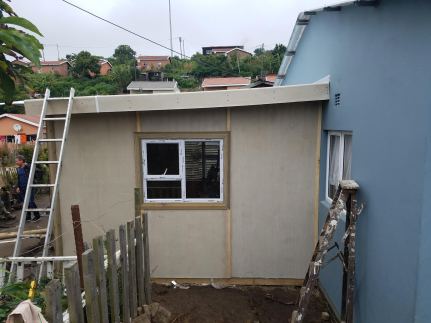
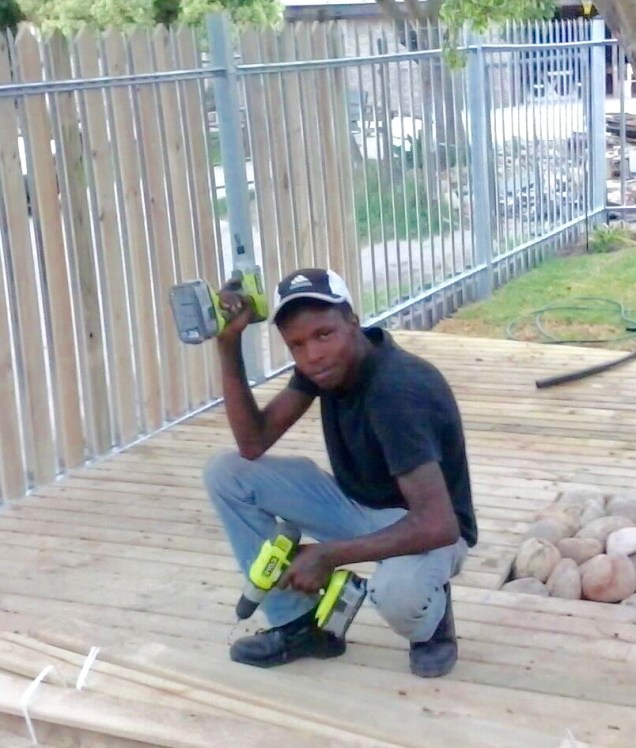
To help Maria and Freddy with space, Kurt and our friend Don have been teaching a group of 8 guys basic carpentry skills.  These boys did not complete high school, some cannot read.  This was an opportunity to teach them some basic skills to hopefully make them a little bit more employable.  Their final project was to build a 12 X 12 sleeping room onto Freddy and Maria’s home.  This gives the family space to move 4 -6 of the children into a room of bunk beds.

unnamed-28
The finished sleeping room.

The project was amazing.  Not only did it give Maria’s family more sleeping space, it was such an exciting accomplishment for the young boys in the class.

unnamed-7
New sleeping room.

Freddy and Maria are Christians.  Maria praises our Savior all day long.  It gives me such joy to visit and see her love for our Lord.  Together this couple teaches their children kindness, compassion, love, grace and mercy.  They instill in them the importance of an education.  Maria told me that in her house, nobody is allowed to drop out of school.  They are raising these children to be good productive members of society.

Because Freddy and Maria opened their hearts and their home, six children have a new lease on life.  I am thankful that they obeyed God’s call on their lives.  Well done good and faithful servants! ~Tracy Cooper

Gang to Grace

“Therefore if anyone is in Christ, he is a new creature; the old things passed away; behold, new things have come.” ~ 2 Corinithians 5:17

Gerald Johnson was born in the Joodsekamp area of the Knysna township in October of 1990.  This was just a couple of months before our second son was born.  Had we been living in the same part of the world at the time, Gerald could have grown up with my boys.  I imagine they could have thrown the baseball around or played video games together.

Instead, my boys grew up with a very different childhood than Gerald.  Upper middle class.  Taking so many things for granted… a home, food, transportation, education, family, sports, and endless opportunities.

For Gerald, life was much different.  He was the son of a Xhosa father and a coloured mother in a poverty stricken township.  The child of a marriage not accepted by his Xhosa grandparents.  To make matters worse, when Gerald was only 2-years old, his father died in a work accident (he worked with a tree feller).

unnamed-2
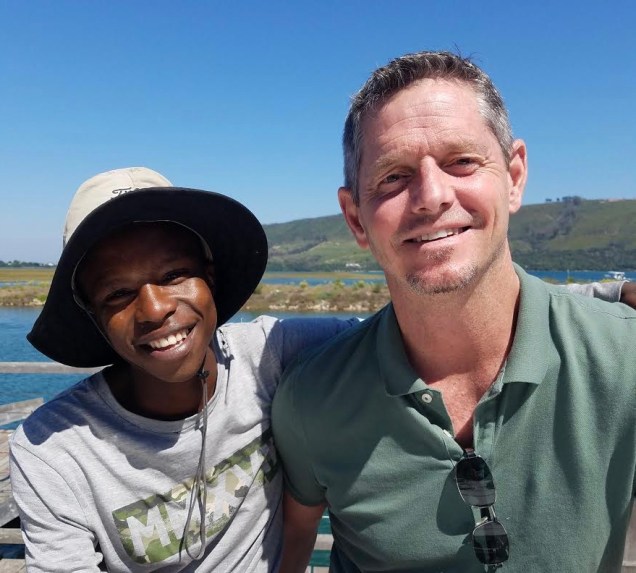
Gerald and Kurt

This set Gerald’s life trajectory in motion.  His dad’s parents decided to start selling off everything Gerald’s father owned… including his home.  They said his mother had no claim to any of it, as she was “just” a coloured woman.  A nothing.  And within the next couple of years they even managed to take her children from her (Gerald and his half-sister), pushing her out of their lives.

This was hard for Gerald.  He loved his mom.  He needed his mom.  But he had no choice in the matter.  He was just a small boy.

Gerald doesn’t complain about the years with his grandparents.  They kept food in his stomach and a roof over his head.  And although his grandfather was strict, he cared for him well.  It wasn’t enough for Gerald.  This young boy missed his mom terribly.  So at the age of 9, he ran away to find her.

From that time on, Gerald found himself in and out of the foster care system.  Sometimes he was placed with families, other times in the government orphanage.  He even had a short stay with his mom.  But she is an alcoholic and could not care for him.  He always landed right back in foster care.

unnamed
Dorothy Broster Orphanage where Gerald lived at one time.

By the age of 13, Gerald took off running.  Running from the system.  Running from the pain.  Running from Knysna.  He ended up in a town called Sedgefield about a 30 minute drive from Knysna.  There he came across some boys he knew from the orphanage and joined them sleeping on the streets.  Their only means of survival was to steal.  Mostly food.  They just needed to eat.  It was a horrible life.  But it was his life now.  Then Gerald made the mistake of robbing the wrong man one day.  A man who was known for beating kids to death if they stole from him.  When Gerald realized this, he ran.  He ran all the way back to Knysna in fear of his life.

Some of his story gets a little foggy.  I say this because Gerald’s coping mechanism was to escape his life by smoking marijuana and mandrax.  He does know that in 2004 he somehow ended up in a school for wayward boys.  And sometime in 2005 he was back living on the streets in Knysna.  A 15-year old boy, sleeping in a cardboard box in the taxi rank in town.  It breaks my heart when I stop here and remember what my boys were doing at 15… attending a good high school, playing on sports teams, working a part-time job, learning to drive, and much more.  Certainly not sleeping in a cardboard box and wondering whether or not they will have food to eat.

One day while hanging out in the taxi rank, a coloured woman (Blanche) recognized him from when he lived in the orphanage.  She was a Christian woman and used to lead Bible Studies there.  She opened up her home to Gerald and he lived with her family for about 1-1/2 years.  He was back in school, had a roof over his head and food in his stomach.  Yet, because he couldn’t understand the love this family was offering to him, he ran.

He traveled all the way to Capetown this time (a 5-hour drive away).  There he slept on the streets.  He was a beggar and a thief.  He started to learn about prison number gangs, the 26s, 27s and 28s.  He soon aspired to be part of one.

Meanwhile, back home in Knysna, Blanche had different plans for Gerald’s life.  She tracked him down in Capetown and brought him back to live with her family in Knysna again.  It didn’t last.  Gerald soon ran back to the streets.

Gerald2
Gerald working with Kurt at YFC.

“Why?” I asked Gerald.  “Why would you throw such a great opportunity away?  A bed, food, education, a family?”  He tried to explain it to me.  What he came up with is that he didn’t understand nor could he accept their love.  He wasn’t worthy of it.  And he feared disappointing them.

If it was possible, this time on the streets was rougher.  Gerald met people that had been in the Numbers Gangs in prison and he so wanted to belong to the group with them.  This required certain things.  One of which was to steal for them.  Well, that was no big deal.  He has stolen many times before.  But this time was different.  It wasn’t for food.  It wasn’t for survival.  It was for acceptance.  Acceptance into a gang.  And there just seemed to be a danger about it this time that he couldn’t shake.  He did it anyway.  And he was right.  The police showed up and he and his cousin/brother ran.  Both went different directions.  Gerald picked the wrong way.  He was caught and put into the police car.  As the police drove him around to the other side of the house, Gerald was horrified.  There he saw his cousin/brother.  Hanging on the spiked fence.  Dead.  It appeared that he slipped when climbing the fence and was pierced in through his rib cage and out through his neck.  A tragic, horrific site Gerald will never forget.

And so it began.  At age 16, Gerald was sentenced to 5 years at a juvenile detention center.  Not a place of rehabilitation.  Not even close.  This was the place he learned more about gangs.  More about crime.  More about drugs.  When he was released, he continued on a path of crime.

Gerald didn’t share all of his criminal activity with me, but I know he landed himself right back in prison for robbery.  Prison this time.  Not juvenile detention.  Prison, home of the Numbers Gangs! 

In South Africa, numbers gangs control the prison populations.  Once prisoners are sentenced by the South African Department of Corrections (DOC), they are classified into 3 different categories. These categories are either economic offense, sexual offence or a crime of violence. This determines what gang they will join upon arrival. The 26s are thieves, responsible for gambling, smuggling and accruing wealth in general. The 27s are the guardians of gang law, murderers.  And the 28s are the most senior gang, the warriors.  They accrue wifies within the prison population by raping new prisoners.  They are also in charge of the flow of food supply.  There isn’t a prison in South Africa without numbers gangs.  It is a nationwide brotherhood.  New prisoners are recruited upon entrance.

Gerald worked his way up the ranks of the 26s, eventually becoming a Judge.  This is a high ranking officer who decides the fate of those that break the rules.   Consequences can range from beatings, to rape, to death.  Even though Gerald was willing to tell me his rank in the 26s, he would not disclose what it took to move up in rank.  Nor would he share the many secrets held by each gang.  Members that betray the gang and share the secrets are not safe in any South African prison (or outside). The secretive nature of the gang makes their system of communicating to other prisons unknown. This is what makes them the most dangerous prison gang in the world.

Gerald
The stars on Gerald’s shoulders show that he is a Judge in the 26s.

A thug.  A gangster.  Gerald was released from prison in April of 2017 (now 27-years old).  People in the township knew who he was and “feared” him.  He was a high ranking officer in the 26s.  Non-ranking members of the 28s in the township feared he would steal their recruits because of his rank.  This led to an attempt on Gerald’s life.  In November 2017, a “soldier” of the 28s stabbed Gerald with a knife.  Left him to die.  And he should have.  It was plunged 2 inches deep into his heart.

God had other plans for our friend.  Gerald spent weeks in the hospital trying to survive and then recuperate.  Doctors convened trying to decide if his body could handle heart surgery.  They decided it couldn’t.  Instead, they inserted a drain and  after a month’s stay, Gerald was sent home.

Still bandaged up, he went back to his old way of life.  A thief.  This time, this theft, changed his life forever…

Gerald stole a phone from a younger boy (Danville) in the township. What do you know?  It was the wrong boy to steal from.  After the robbery, Danville was riding in the car with our friend Chris (a missionary now living in Knysna) and discretely pointed Gerald out to him.  Much to Danville’s horror,  Chris stopped the car to confront Gerald.  This was Gerald.  Judge of the 26s.  I’m guessing Danville slid down in his seat, out of site.  Well, funny thing.. not only did Chris get the phone back, but he took time to share something with Gerald that would change his life forever.  He shared Christ.

Hungry to hear more, Gerald met with Chris the following day.   He heard that his life matters.  He is highly valued.  God loves him so much, that he sent his son to die on the cross for him.  Gerald’s heart was finally healed, spiritually.  He accepted Jesus Christ as his Lord and Savior.  And in February, Kurt and I had the privilege of watching Gerald publicly profess Christ at his baptism.

unnamed-1
Gerald’s baptism.

I wish I could say Gerald’s life is easier now.  It isn’t.  He still lives in a run down shack that costs about $25 U.S. per month to rent.  His long time girlfriend broke up with him.  His mother is still an alcoholic and losing her eye site to cataracts.  

What I can say is that his life is better.  He focuses on what he does have.  He has a brand new job at a glass company (his very first job ever).  He has a new family in Christ.  He has joy.  Most of all he has Christ!

A true story of God’s redeeming love.

Our God is an awesome God! ~ Tracy Cooper


The “Unprotected” – Part 2

“Every child deserves a champion — An adult who will never give up on them, who understands the power of connection, and insists that they become the best that they can possibly be.” – Rita Pierson

In my earlier blog post,  “The Unprotected”- Part 1, I introduced you to four of the children living in the Lukhanyiso Safe House with Mamma Ella.   Now, I will tell you how the Safe House came to be, and introduce you to a few more of Ella’s precious children.

In isiXhosa, the word Lukhanyiso means “The Light”.  Ella decided to call the Safe House Lukhanyiso to bring Light to the brokenhearted.

unnamed-9
Ella’s Safe House.

I met Ella in 2014 on my first trip to Knysna.  Two of the things I love about her is her passion to help people and her passion to share Jesus.  She is ALWAYS on the go looking for people in her community to help and share the Good News.

Ella Mapurisa (Mamma Ella) grew up in the Eastern Cape of South Africa.  When she was 6-years old, her parents divorced and her mother found employment on a farm, moving Ella out to a very rural area.  In order to get an education, Ella had to walk over 6 miles to school every day.  She did this with no shoes for several years and vividly remembers getting her first pair of shoes at 12-years old!  

Because her mother was an alcoholic, she was not always able to function at her job.  Ella soon had to step in and cover for her mom.  At just 9-years old, she was trying to go to school and complete her mother’s chores on the farm.   She knew that if she didn’t, the two of them would be kicked off of the farm and left homeless.  This was a lot for such a young girl to carry.

With no guidance and no support, she dropped out of school at the age of 16.  It had become too much.  Too far to walk.  Too much work to be done on the farm.  And no money to buy her books. 

 In addition to the pressure, her living/work conditions became volatile.  It was not safe for a Xhosa girl to be working on a farm…  a farm owned by a white Afrikaans farmer…  during the Apartheid era.   Ella was abused.  Unprotected.  Trapped.  No real education.  No money. No connection to people off of the farm.  No hope.

Until…  At the age of 22, a missionary came to the farm and told her about the love of God. She did not believe there could be such a love.  She had never experienced true love from anybody before. She desperately wanted to be loved.  But she feared if she accepted this Jesus, she would only prove the missionary wrong.  There could not be such a love.  Could there?  In the days to follow, she accepted Jesus Christ and her life was forever changed.  The missionary took her home with seven other children and helped to cultivate a strong faith in her.  He put her back in school at the age of 22-years and finally at 25-years old, Ella matriculated from High School.  It was then that she moved to Knysna to start her new life.  A life full of love, hope and faith.

There is a lot more to Ella’s story, and the impact of it all shaped who Ella is today.  She knew that “when” not “if” she was able, she would pay it forward.  She would help women and children living in fear and danger.  And she would share her Jesus with everyone!  Her strong Christian faith and her positive attitude kept her moving forward toward her goal.

Now, self-employed and co-owner of Emzini Tour Company (Township Tours) she knew it was time to help.  Time to build a safe house, a refuge, where women and children can go when they are in danger.  The tours are designed to show a positive side of the townships, and create an income to support the Safe House.

Currently, Ella has 14 children living in her home and has agreed to financially support 12 others.  We met 4 of these children in an earlier blog.  Today I would like to introduce you to a couple more…

Siblings: Imange and Takunda

Imange is now 10 years old, but came to live with Ella when she was just 5.  She is a very gentle and sweet young lady.  At the age of 5 years, Imange and her 2-year old brother Takunda were left at home alone when their parents decided to just walk away.  Walk away from their two young children!  We are not sure how long they were alone, but when the children were found, Imange was actually cooking, feeding and caring for her younger brother.  Image was 5-years old!  Even so young, Imange showed such great love for her little brother, and still does today.

Takunda, a soft-hearted little chatter box, is 7-years old.  He really never knew his parents since he was only two when they walked out.  His birth name is Lithala, but his grandmother was calling him Madala (which means “old man”).  Ella’s husband said, “We can’t have a child being called Madala.  I am going to call him Takunda” (Takunda is a Shona word meaning Victory!).

These two siblings are no longer living in the Safe House.  Unfortunately their grandmother insists they live with her so that she can receive government money.

unnamed-32.jpg
The shack that Imange and Takunda live in with their grandmother.

Knowing that the children would not be cared for properly, Ella continues to pay for all of their schooling, clothes, transport to school, after care, food and other needs that arise.  Although they are not under her roof, they are still part of Ella’s family!

Meet Abigail

Abigail, a complicated 14-year old, comes from a very rough background full of drugs, alcohol and uneducated family members . She is the only person in her family to ever attend school; and that was not on a consistent basis.   There was no food and no supervision in her household.  As a very young girl, she found her way to Ella’s  looking for food.   She continued to visit for food and started to trust Ella.  Soon Ella learned that at 6-years old Abigail was sexually molested.  It was then that Ella moved Abigail in with her.

unnamed-1
Abigail


The trauma this young girl survived is devastating.  She has a lot to work through and is highly needy for attention.   She is healing.  Slowly.  Abigail now attends a private school in town where she found she has a true talent in Hockey.

unnamed
Abigail playing hockey.

Please enjoy this Vlog of Ella on one of her township tours:

If you feel called to sponsor one of Ella’s children on a monthly basis, or make a one-time donation, please click on the link below and follow the steps. In the comments, type Lukhanyiso Safe House.  All donations are tax deductible and will go directly to the care of Ella’s children.  ~Tracy Cooper

https://mygiving.secure.force.com/GXDonateNow?id=a0Ui000000WKZkVEAX