Wallow or Withstand?

“The tests we face in life’s journey are not to reveal our weaknesses but to help us discover our inner strengths. We can only know how strong we are when we strive and thrive beyond the challenges we face.”
― Kemi Sogunle

We all tend to wallow in our unfortunate circumstances at times.  It gives us a little time to feel sorry for ourselves, and maybe, just maybe, get others to feel sorry for us too.  But then, we must take the step to move on.  Pick ourselves up.  Dust ourselves off.  And continue to travel along this journey called life.

What happens if you live your life continuing to wallow instead of choosing to withstand?  You define yourself as the circumstance.  Everything you do, every decision you make, everything you see is through a tainted lens.  A perspective of … “well, this happened to me, so …”  And unfortunately, I believe life passes you by.

I have written the stories of many of my friends here in Knysna, South Africa.  So many tragedies.  So much poverty.  So many unfortunate circumstances.  However, I love being able to share how many have overcome and withstood the test of this life.  They don’t wallow in their circumstance nor allow it to define them.  Instead, they learn from it, overcome it, withstand it and move forward.  When I have them read their story in writing, they are amazed at all that they have truly withstood over the years.

Today, I’d like to introduce Dyllan.  I met him 2-years ago when he was participating in the “Hands and Heart” program sponsored by Youth for Christ.  He has wanted me to write his story since the first day I met him.  “Why?”, I wondered.  Everyone else is so reluctant to share their stories.
0-3.jpg
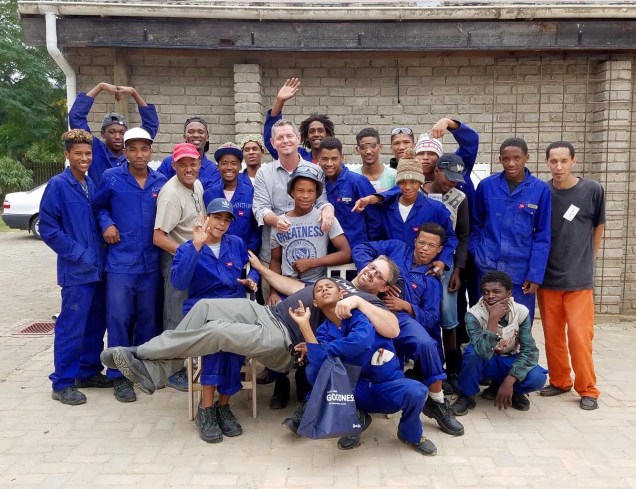
Hands and Heart Class of 2017

(*Sidenote – “Hands and Heart” is a 1-year skills training program.  Boys who have dropped out of school are given the opportunity to learn basic construction skills and welding.  They attend class 4-days per week for the entire year.  From there, men in the community work on the boys’ behalf to help them secure jobs.)

When you read this young man’s story, it is obvious he has suffered through many serious health issues.  No doubt.  But you, the reader, must decide for yourself whether you think he will choose to wallow or withstand…  Will he allow his circumstances to define who he is?  Or will he push through?
0-1.jpg

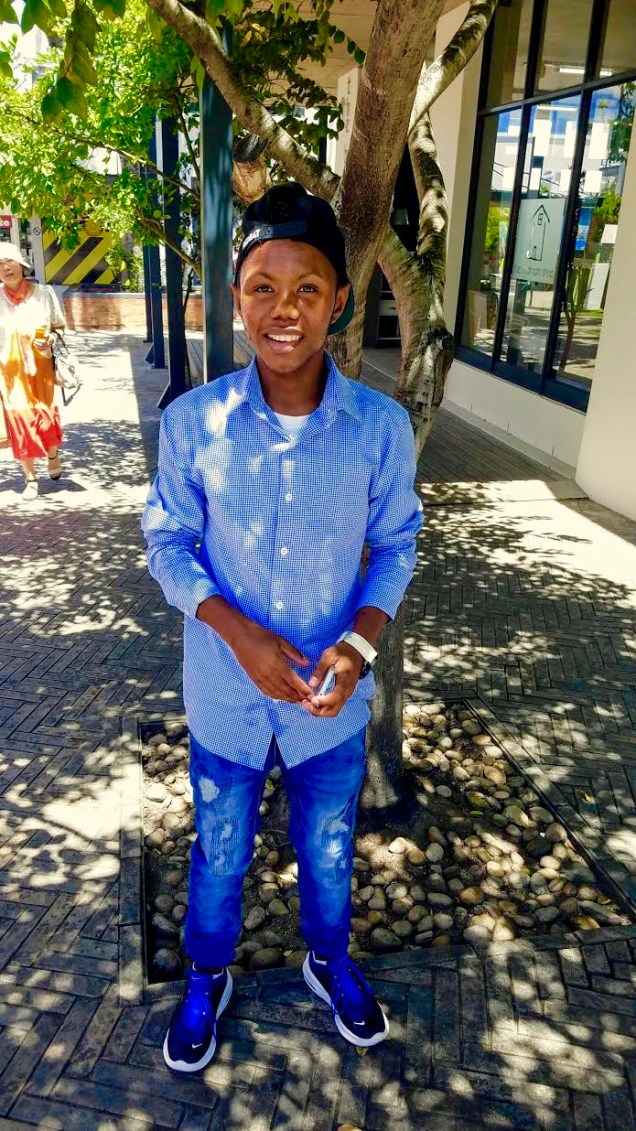
Dyllan Muller, the ever smiling 21-year old, was born and raised in the Hornlee area of Knysna, in the Western Cape of South Africa.  Hornlee is home mostly to the “Coloured” residents of Knysna.  You can read a little bit more about the history of apartheid and designated living areas in “What is a South African “Township””.

Dyllan’s parents brought their baby boy home to their ever-growing family back in 1998.  He was their third child joining a 3-year old brother and 5-year old sister.

Within 7 months of his life, he was diagnosed with kidney failure in both kidneys and placed on dialysis immediately.  A 7-month old baby on dialysis.  This became this little baby’s life.  Traveling back and forth to Cape Town (a 5-hour drive away) to receive treatment at a much more equipped hospital.

By the time Dyllan reached age 3, his father walked out on the family.  A story like so many others.  Dyllan remembers his dad yelling at his mother often and believes he struggled with alcohol addiction. 

So there they were.  A single mom left to raise three young children on her own… one who was very ill.  A child she must travel often with to Cape Town for treatments.  And two she must leave behind each trip.

Throughout the years, Dyllan received Peritoneal Dialysis.  He was either in the hospital in Cape Town or sent home with a machine.  This worked for a couple of years until he developed a terrible abdominal infection at the age of 5.

(The most common problem with peritoneal dialysis is peritonitis, a serious abdominal infection.  This infection can occur if the opening where the catheter enters your body becomes infected or if contamination occurs as the catheter is connected or disconnected from the bags. Infection is less common in catheters, which are placed in the chest. Peritonitis requires antibiotic treatment by your doctor. – nationalkidneycenter.org)

In order to treat the peritonitis, Dyllan was placed on strong antibiotics. He was then switched to Hemodialysis, where they inserted a catheter into his neck while he continued to wait for a kidney transplant.

During the course of his treatments, Dyllan’s hearing declined.  He tried to keep up with school.  It was tough.

By grade 5, Dyllan was 12 years old and his health was failing drastically.  He missed the entire year of school as he was in and out of the hospital.  He finally received a kidney transplant in 2011.  Things were looking up.

When he returned to school, the administration pushed him through grades 6 and 7.  He was not passing.  Not receiving the educational foundation he needed.  Still he was moved ahead.

While attending grade 7 at age 15, Dyllan’s hearing had declined so much that he had become completely deaf in both ears.  The doctors believe that it was caused by the intense antibiotics and treatments he received over the years.  This young kidney recipient was now deaf.

Learning of his story, a doctor in Cape Town suggested that Dyllan would qualify for a Cochlear Implant through Stellenbosch University’s Project Hope.  This meant that the surgery would be subsidized if Dyllan’s mom could raise R30,000 of the R189,00 needed (approx. $3,000 of $15,000).  This is a lot of money for most people, let alone a single mom working for minimum wage (approx. $12 per day… not per hour… per day).

Dyllan’s community heard of his need.  They showed up in a big way.  The students and faculty  at his school, Sunridge Primary, joined together to donate money.  The local newspaper printed an article asking for supporters.  It worked!  Dyllan received a Cochlear Implant in 2012 and can now hear in one ear.

Dyllan was happy he could hear again.  But going into the surgery as a 15-year old, Dylan knew nothing about Cochlear implants.  He had no idea that when he awoke from surgery, he would have a permanent small box attached to his head.  Nobody prepared him.  Now, 7 years later, he still won’t allow people to see it.  He wears a hat or headband at all times.

Everything should be fine now, right?  Not quite.  Dyllan was so far behind in school.  Even though he wasn’t passing, he kept getting pushed along, until he finally dropped out in Grade 10.

This decision left Dyllan with few choices of a future career.  A decision made by so many boys in the townships.  But then Dyllan got a break.  He was accepted into Youth for Christ’s “Hands and Heart Program”  where he learned basic construction skills.  He completed the program and secured a job.

A dream for many high school dropouts. 

Weeks after beginning his construction job, Dyllan quit.  Due to his previous health issues, he felt he really shouldn’t be doing heavy lifting.  Unfortunately he has not found another job in the past 2-years.

So, I ask you… Is he wallowing or is he withstanding?

I believe Dyllan is at a crossroads in his life.

Dyllan can either see himself as a boy who suffered kidney failure and lost his hearing.  Thus putting many conditions on possible jobs.  A boy who wants to tell his story so that others will feel sorry for him and continue to wallow in his circumstance.

OR

Dyllan can see himself as a successful kidney recipient who has had his hearing restored with a cochlear implant.  A young man with a second lease on life.  A person who has withstood the unfortunate circumstances life has given him and wants to tell his story to others to inspire them.

Only time will tell if Dyllan will wallow and let his unfortunate circumstance define who he is.  Or if he will withstand the test and see the blessings he has received.

The choice is his.
A Lesson in Patience

“Patience is not the ability to wait, but the ability to keep a good attitude while waiting.” ~ Joyce Meyer

I spent a day in a South African hospital last month, with my new friend Siphewe.  I had the opportunity to meet her when I arrived this year.

Siphewe was involved in a car accident in the Bongani area of the Township on December 24.  Christmas Eve.  She had put herself in a compromising situation that unfortunately left her with painful consequences.  With 6 people crammed into a car, no seatbelt and a driver under the influence, the car in which she was traveling struck a concrete wall.  Siphewe was thrown around and broke her back.  She was the only one injured.

Afraid he would be in trouble with the law, the driver and the other passengers removed Siphewe from the car, called an ambulance and left her on the side of the road.  These people were her friends.  Or so she thought.  The police were not called.  No report was made.

Siphewe woke up in the Kynsna Hospital with no recollection of what had happened.  Her friends tried to convince her that she fell down a flight of stairs.  They did not want their secret revealed.  And although Siphewe lay there on a hospital bed with a broken back, her friends continued to cover for the driver.  She eventually started remembering the events that took place before the accident and was able to put the pieces together.

unnamed-7
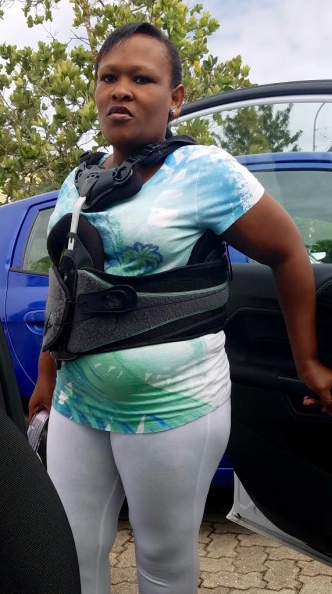
Siphewe – still in pain, 10 weeks following the accident.

I met Siphewe in January, because her family had been struggling to have enough food to eat.  She is a 30-something year old woman with her elderly mom, an 18-year old daughter, 18-year old nephew and his pregnant girlfriend, and 21-year old niece all living together in a 2-bedroom concrete home with a shack in the back.  Because of her broken back, Siphewe was unable to work.  Therefore, shy on money.  I was asked to deliver some food to her family.

The day I met Siphewe, I liked her.  She is very sweet.  Quiet.  Kind.  I could tell she was in pain as she sat on the couch with a back brace, softly talking with me.  She had just been released from the hospital the week prior to our meeting.  As we talked, she mentioned that she was scheduled for a follow up appointment at the Hospital in George (1-hour away).  I told her that when the time came, I would be happy to drive her.  I couldn’t imagine her riding in a packed taxi with a broken back. (A taxi is a 15-passenger van)

Well… my experience in the South African Public Hospital was a true lesson in patience! 

Here in South Africa, 84% of the population (45 million) poor, mainly black women, men, and children rely on government health care.  People pay for services based on income.  These state facilities are often over-burdened and under-resourced. The remaining (9 million) people are medical scheme members (those with medical insurance).  These people have access to good but very expensive private hospitals.  These centers are more efficiently run and less busy.  The quality of care in this two-tier system varies drastically.

I experienced the first.  A government run hospital.  And it was like nothing I have ever seen.

Siphewe had a scheduled appointment with a doctor at the hospital for 8:30 a.m.  I picked her up at 7:00 a.m and we drove a little over an hour to the hospital in George.

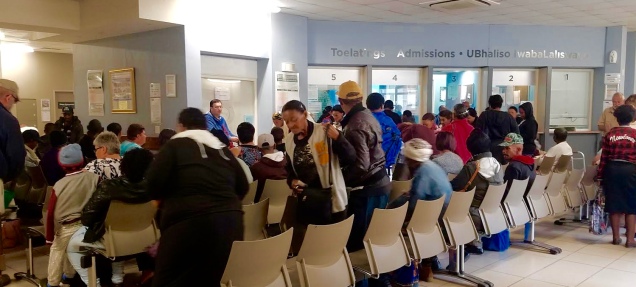
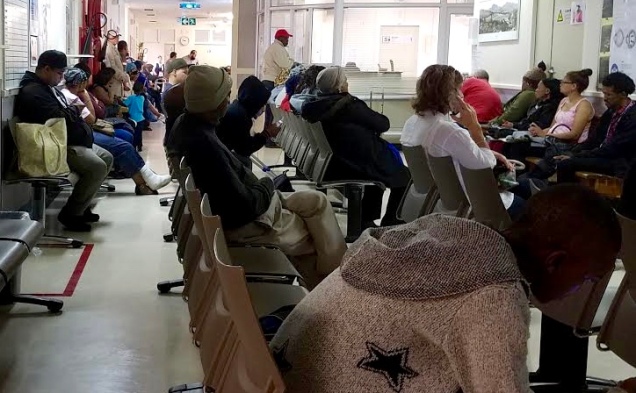
I parked the car and we walked in to the main lobby before 8:30.  We were on time.  But it didn’t really matter.  It was packed!  At least a hundred people or more were already waiting.  Then I noticed the strangest thing.  Everyone that was seated would get up together and move to the next seat.   Over and over again.  It was a huge queue of chairs.  So, we got in line.  Sitting, standing and moving over to the next seat at the appropriate time with everyone else.

unnamed
First queue to pick up her file.

After 1-1/2 hours, it was finally our turn to go up to the desk.  We made it!  Little did I know that this line was just to pick up her file.  Next, we were to go upstairs to see the doctor.  Ok.  Good.  Let’s go.

As we got off of the elevator, there was a line of people in wheelchairs down the hall (in the wheelchair waiting area).  We walked past them to enter the waiting room full of dozens of people again!  I looked at Siphewe, I could tell she was hurting.  After all, she has a broken back!!  We found seats and sat there quietly as did everyone else.  Waiting our turn.  Waiting our turn a little longer.  Waiting our turn even longer.  Then her name was called… 4 hours later.  Yes, 4-hours after getting upstairs to where the doctor’s office was located, her name was finally called.  Woohoo, here we go.  Siphewe walked into the office, closed the door behind her and was back out within 2 minutes.  What?  How can she be finished already?  We waited 5-1/2 hours for a 2 minute exam?  

unnamed-5
Sit, Stand, Move over a seat.

Haha.  No.  “We must go downstairs to get an x-ray”, she told me in her quiet voice.  Well of course.  I figured she would need one.  This was, after all, a follow-up for a broken back.  Really?  They couldn’t have sent us to x-ray first?   It took, at this point, a  5-1/2 hour wait for a doctor to tell us to go get an x-ray.

While I was trying to be patient, Siphewe was patient. This is how things are done here.  Nothing out of the ordinary.  Go from this line to that.  Sit, stand, move over.

Downstairs to x-ray we go.   You guessed it.  Another line.  This one was only 1-hour though! 

My patience was really running thin when I found out that our next step was to go back upstairs to see the doctor that we had waited so long to see earlier.  He needed to look at the x-ray and determine what to do next.  What if we have to wait another 4-hours for him?  Fortunately he only kept us waiting for about 30 minutes this time.  He prescribed some pain medication for Siphewe and basically told her it would just continue to heal on its own.  To keep wearing the back brace and return in another 6-weeks.  Wow, all that time for the doctor to say, keep doing what you’re doing and come back and repeat this process again soon.

More than ready to leave, I escorted Siphewe back downstairs to the main lobby.  Before we got to the front door, she said we needed to stop at the pharmacy in the hospital to get her medicine.  I bet you can guess what I saw when we got there.  Yes… another line!  One more hour of waiting.

unnamed-6

8-hours for a scheduled appointment. 

As I sat there agitated and frustrated with this ridiculous process… Siphewe, the one with a broken back and in so much pain,  exhibited patience and grace.  She had received care.  That is what mattered.

Sitting, standing and moving over a seat.  Never complaining.   ~Tracy Cooper

What is a South African “Township”

township

I realized after I posted my previous blog “Growing up in the Township”, that many of you may not know what a “township” is.

When Kurt and I first decided to come with a mission team (2014) to South Africa to work in a township, I had no earthly idea what a “township” was.  I envisioned a “village”.  Huts.  No running water.  Little to no electricity.  Women carrying baskets on their heads, etc.  You know, National Geographic stuff.

That is not what I found.  And although a township is not like the “village” I pictured, it is vastly different from first world living as we know it… I would call it second world.

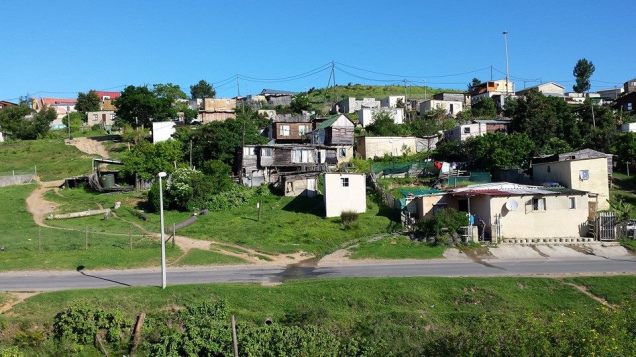
In South Africa, the terms ‘township’ and ‘location’ are used interchangeably. My friends in the township usually call it “The Location”, while my friends in town call it “The Township”.  Anyway, the terms refer to an undeveloped segregated urban area.  These were areas set aside for non-whites to reside … Blacks, Coloureds and Indians during colonialism and then again during the  apartheid era.  They are built on the periphery of towns and cities.

During the apartheid era, “white only” living areas were established and non-whites that were living in these areas at the time were evicted and forced to move into segregated townships. Separate townships were established for each of the three designated non-white race groups (Blacks, Indians and Coloured: mixed race).  If you read Trevor Noah’s book, “Born a Crime”, you will learn a lot about South African Coloureds.  He puts a humorous spin on a not so humorous life.

Since apartheid ended in 1991, all people have legally been allowed to reside where they choose. However, financial strain has kept lots of people of color living in the townships.  This is because although whites are a minority in South Africa, they are the financial majority.

My first time here, Kurt and I took a “township tour” (Which I highly recommend if you ever visit South Africa).  I convinced myself that people who live in the townships must try to do anything and everything they can to move out.  To live in town.  In neighborhoods like many of us.  Why?  Because I saw this as oppression.  They MUST rise above this way of living. 

Then I started to ask questions of the friends I made living in the township…

“If you dreamed of and had success in financial terms, what would you do with your money?” I asked.  “I would build a house for my mom”, is the #1 answer.  Mom is the answer, because most likely she is the one who has not walked away from the family.  She may or may not be a good mom.  She may be a faithful mom or a scarce alcoholic.  She may be tender and sweet or violent and angry.  It doesn’t matter.  She stayed!

So the question that follows is, “Where would you build this house?”  Not to my surprise the answer is “Knysna”.  This area is so absolutely beautiful.  It is the paradise that many inland South Africans come to vacation.  Hills, mountains, beaches… a coastal town so full of God’s beauty!

Next question, “Where in Knysna would you build this house?”  This is where I fully expect them to name one of the gated, golf-course communities.  The pristine neighborhoods with large homes overlooking the Indian Ocean. No. “The Location” is the answer.  Not sometimes.  Always!

Stunned, I ask, “Why?”…  “Because this is our community.  This is where our family lives.  This is our home.”

I get it

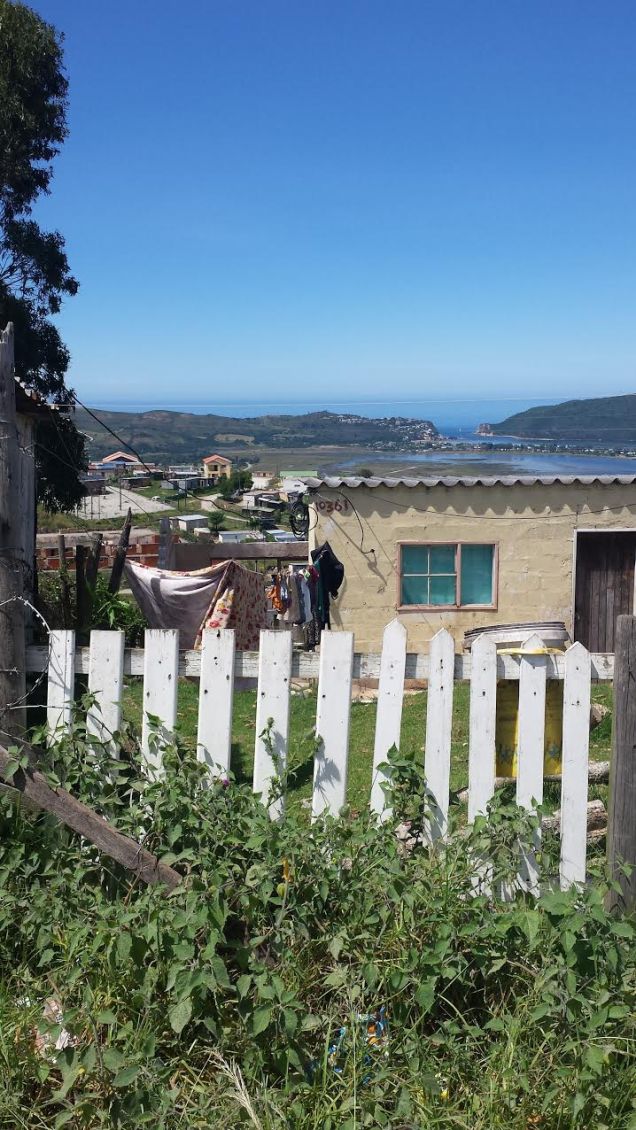
As an outsider, I saw falling down shacks, rows of small concrete homes and narrow dirt roads.  I saw unfamiliar life styles, people of color flooding the streets and children playing with old tires and sticks.  I saw roaming unattended animals… dogs, pigs, cows, donkeys and chickens.  I saw everything that does NOT resemble MY community at home.  I saw poverty and feared the danger it may bring.

20170213_141701
Large shack

But as I traveled through the township daily over the years and got to know the people…  I mean really got to know them, I started to see things differently.  Now I see the homes of families and friends.  I see convenience stores, hair salons and tailors (all located in metal shipping containers or shacks) as local businesses convenient to walk to.  I see the primary schools and high schools children attend. And the creches (preschools) caring for babies and toddlers.  I see the clinic, library, churches and fire station helping to serve basic needs. I see security in a community.

unnamed

That is why I get it now.  These are many of the same things I want, need and demand in my own community.

The problem is this… with 55,000 people living in the township in Knysna, the infrastructure is not sufficient to meet the needs of this community.  School classrooms have 50 and above children per class.  50+.  OK teacher friends… Just picture that!  Standing room only.  Not enough desks, chairs nor textbooks for the students.  And believe it or not, even with those numbers, they do turn kids away.  Some children may not be offered an education!  Can you even imagine?! 

Finally, although the townships have many things needed in the life of the residents; people who live there cannot avoid trips into town.  They must travel to town for jobs, groceries, retail stores, skill centers, hospitals, police stations, post offices, gas stations and many other things.  Very few own cars, so they must walk or take a taxi (15-seater van) that travels to and from town.

Things aren’t easy for those that live in the township.  There are stumbling blocks around EVERY corner.  But it is life.  It is township life.  And every day that I am here, I have the privilege of doing life together with my new friends.

I serve an awesome God.  ~ Tracy Cooper

The Journey Begins

Thanks for joining me!

“Good company in a journey makes the way seem shorter.” — Izaak Walton

I am going to try my hand at blogging while Kurt and I are in South Africa this year. I have never written a blog before, so please bear with me.

“Why are you in South Africa?”, you may ask.  Well it is a story only God could write…

For many years, I would always joke with people saying that when Kurt retires, he will probably “drag” me to some 3rd World country to be in ministry.  Fast forward, here we are in Knysna, South Africa.  It isn’t 3rd World, but it is definately 2nd World.

So how did we get here?  After Kurt retired in January 2014, he began to meet with the University of Virginia to learn about their water purification “system” (local potters make porous pots lined with silver), in Limpopo, South Africa.  After meeting with those involved with this project a couple of times, they recommended he go visit the site in order to understand the site work that needed to be designed.  Since he and I decided I would go with him, we thought we would make a vacation out of the trip down (as it would probably be the ONLY time we would ever come to Africa).

One problem, we knew nothing about Africa.  I certainly did not realize how big the continent is compared to North America.  Africa is bigger than China, India, the contiguous U.S. and most of Europe—combined!  So, how do I begin to plan a trip?  I would tap into my resources or as many would call, FRIENDS.

I happened to know only one couple that had ever been to Africa and their trip was to Kenya, not South Africa.  But as God would have it, this couple had just recently met a man who was born and raised in South Africa, but now lives in Augusta, Georgia.  My friend recommended I email his friend to see if he could help me plan an itinerary.  After several emails back and forth with this man I had never met, Kurt decided that this project with UVA was not a good fit. Wow, disappointment.  This man in Georgia has spent so much of his time helping me plan a vacation and now I needed to tell him we were not going to go.  I felt bad to have wasted his time.

God had other plans!  It was now August or so and instead of my new email friend saying oh well, so sorry for you; he said that he was taking a mission team to Knysna, South Africa at the beginning of November and invited us to come with him.  I promptly said “Thank you” but “No Thank You”, we have already allocated that money to be used for something else… that may or may not have been completely true.

My new friend did not take “no” for an answer.  Instead he told me to talk to Kurt and pray about it.  Ugh, why did he have to bring God into this?  I know that if I pray about it, I may have to say “yes”.  Dilemma, do I tell Kurt we’ve been invited?

Yes, I did.  And after much prayer, we decided to join the team.  Now it is January 2018 and this is my 5th time back to Knysna.  I love the people here and have made many forever friends.

My passion is to work with young girls and single moms.  This involves tutoring  girls in English and Math and continuing to tweak a “Girls Talk” group we launched in 2016.  Like each of us, everyone here has a story.

Please follow along with me, over the next few months, as I introduce you to my friends.  Their stories can be both sad and inspirational.  But through it all, our God remains faithful.    ~Tracy Cooper