Living a Life on Purpose

“It’s never too late to be what you might have been.” – George Eliot

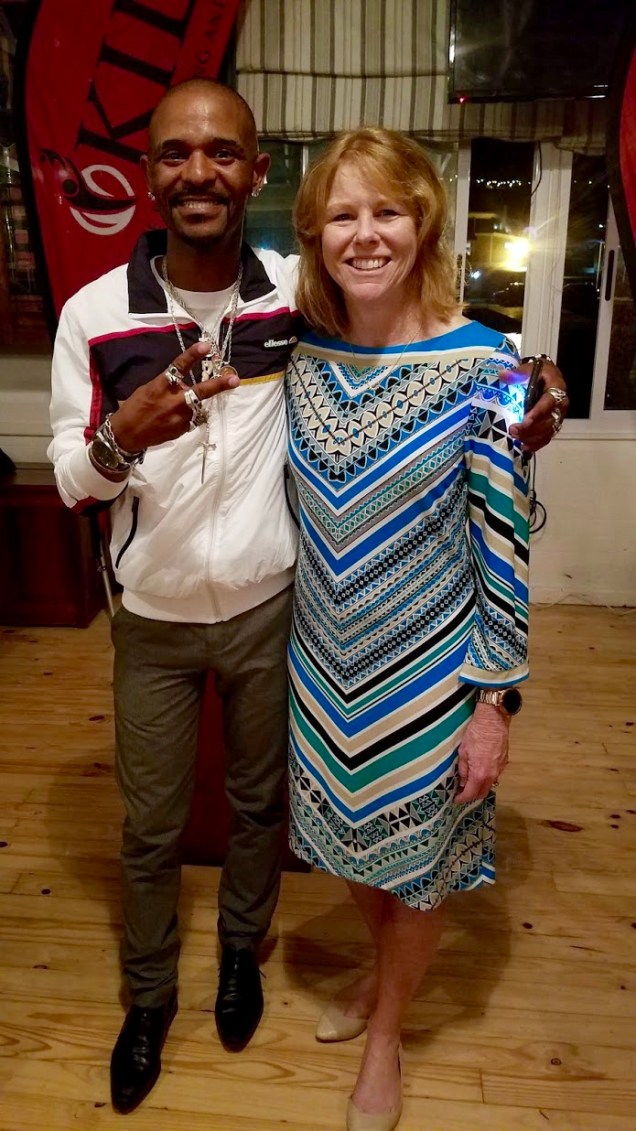
Kurt and I had the opportunity to listen to a former prison gang member address an audience of community leaders, parents and teachers.  Here is his story…

A young boy growing up in the Cape Flats of Capetown, South Africa, Welcome Witbooi was a “Straight A” student in school.  His dad was a successful business man that put high expectations on his son.

Because of his intellect, academic drive and small stature, he was bullied by the other students in school.  When he went home to what should be a place of safety, love and encouragement, his father would tell Welcome he could do better.  What is better than straight A’s?

Because of his low self esteem and his father’s emotional abuse, Welcome was sought out by a street gang.  Gangs sit and observe the community.  They have plenty of time on their hands.  So they sit.  They observe. They wait.  And when the time is right, they pounce.  They are keen to know which children are seeking acceptance and are ready and willing to step in and offer it.

And so it began for Welcome.  At 14-years old, a young man from a gang called, The Firm, drove up in a canary yellow BMW and invited Welcome in.  He befriended Welcome offering him time, money and acceptance.  Welcome was hooked.  He did what he was told to do in order to join the gang.  It started with robbery.  Then progressed.  But he was now part of a group who accepted him.

At 17 years old, Welcome was given his first firearm.  It was time to gain more respect from his gang.  This meant he must take the life of an innocent person.  Before he could, he and seven other gang members were caught in the midst of a home invasion (robbery and attempted murder).  The gang convinced Welcome that because he was the only one under the age of 18, he must take the fall.  The courts would never give him more than two years.  Welcome believed them.  The judge sentenced him to 23 years in prison.

His cocky attitude led him to believe that this was no big deal.  His gang family would be there to visit.  To get him out.  Not once did anybody show up.  He was on his own.

Being in a South African prison is very dangerous.  They are run by numbers gangs.  I don’t just mean the gangs are prevalent.  I mean they run the South African prisons.  As I wrote in the blog post “Gang to Grace”…

In South Africa, numbers gangs control the prison populations.  Once prisoners are sentenced by the South African Department of Corrections (DOC), they are classified into 3 different categories. These categories are either economic offense, sexual offence or a crime of violence. This determines what gang they will join upon arrival. The 26s are thieves, responsible for gambling, smuggling and accruing wealth in general. The 27s are the guardians of gang law, murderers.  And the 28s are the most senior gang, the warriors.  They accrue wifies within the prison population by raping new prisoners.  They are also in charge of the flow of food supply.  There isn’t a prison in South Africa without numbers gangs.  It is a nationwide brotherhood.  New prisoners are recruited upon entrance.

Welcome realized that because of his small stature, he had better figure out how not to be a victim of rape in the prison.  His only chance was to climb the ladder of the 28’s gang.  So that is exactly what he did.  He made it all the way to “General”.  The stars on his shoulders prove it.  Each star represents the murder of a prison warder or another prisoner.  He has 4 stars on each shoulder.

As the senior gang, the 28’s earned money in prison through extortion, prostitution, drugs, etc.  The gangs run so deep and are so interconnected within the prison system of South Africa, they run like a well-oiled machine.  And here was Welcome at the top.  General.  Now called Nongoloza (leader of the 28’s).  Commanding over 2500 inmates.

After years of this life, Welcome was tired.  He says that although he was at the top, he lived in fear.  At any time a lower gang member might try to kill him to try to get his spot.  He wanted out.

Numbers gang members know there is only one way out.  Death.  However, as Welcome reached the highest level, he learned there was another possibility.  Welcome wanted to plead his case.  He wanted a chance to turn his life around.  In order to do that, Welcome had to negotiate with the prison administration to transport four other Generals from four other prisons to his prison to hear his case.  His request was granted.

Four 28’s Generals were brought to Welcome’s prison.  A room was cleared and ready for his case.  Each General stood in the four corners of the room.  Then Welcome was escorted into the room naked and put in the center (naked so that the Generals knew he had no weapons on him).  Two Generals stood in from of him… the “one who sees” and the “one who hears”.  Two stood behind him… the “executioners”.

It was at that time that Welcome said he wanted to retire.  He pleaded his case that he had performed well for the 28’s over the years, but it was time for him to get out.  He wanted to turn his life around.  After he spoke, the Generals escorted him out of the middle of the room and discussed amongst themselves whether he will live or die.  Then he was put back in the middle, facing the same two as before.  However, before the four Generals began their discussion, one turned to Welcome and said thank you for teaching me to read and write.

As Welcome stood in the middle, he had no idea whether this would be the end of his life or the beginning of a new chapter.  The two in front would say he could leave the gang, OR the two in back would stab and kill him.  His life was spared.

Welcome spent two more years in prison before being released.  He believes that the only reason his life was spared and he was allowed to leave the gang was because he taught one of the other Generals, somewhere down the line, how to read and write.

Welcome lived a life of crime and unspeakable acts.  He is not proud of what he did.  But he knows he can use his past to help bring change to the future.

Since being released from prison in 2012, Welcome has worked with offenders who were being introduced back into society.  He works with young boys and girls involved in gangs to get them out. He works with institutions of education to get kids back into school.  Welcome has a foundation that works with children individually, giving them a sense of identity and belonging.

He also conducts parenting workshops to help parents understand the activities their children are involved in.

While here in Knysna, Welcome spent a couple of days in the community.  He walked the streets in day and in night, met with boys involved in gang activities, met with parents, community leaders, school administrators and teachers. 

His mission is two-fold.  To youth, he talks about the importance of education, how to avoid the false sense of security of being in a gang and explains the horrific life of a prisoner.  To adults, he speaks of the importance of responsibility and accountability of the youth in the community.  The parents and teachers must be active in the lives of the children.  Know where they are.  Who their friends are.  The things they are involved in daily.

If good influential adults aren’t there to engage with the youth, the gangs are ready and willing to take their place!

After living the life of Nongoloza, Welcome says he is “Finally, Welcome”.  He is redeemed.  Living a life on purpose.
20190228_205404

Sidenote… Welcome is not only a motivational speaker, he is an actor and an author.  He starred alongside Forrest Whitaker in “The Forgiven”, consulted on prison gang culture for the movie “Four Corners” and has an autobiography titled “All is Not Lost”.

Vigilante Justice – Is there room for it in society?

“Justice delayed, is justice denied.” ~ William E. Gladstone

If I had to write the mantra of a vigilante, I believe it would be, “Justice delayed, is justice denied.”

Vigilante: A member of a self-appointed group of citizens who undertake law enforcement in their community without legal authority, typically because the legal agencies are thought to be inadequate.

** Just a warning… the photos at the very end of the article may be disturbing.

This begs the question, “When is Vigilante Justice acceptable?”  Ever?  Should community citizens take justice into their own hands if they feel overlooked by the local police department?

If I didn’t know the boys involved in Monday’s incident, I may have said, “Well they shouldn’t have put themselves in that situation. ” Or maybe, “They got what they deserved.  If they weren’t guilty this time, they probably did plenty of things in the past that have gone unpunished.”  But I know these boys.  And yes, they have a list of unpunished crimes.  Probably a long list.  But does that justify what occurred on Monday night? 

A “Community Group” (vigilante group) in the township took matters into their own hands Monday night when they hunted down and severely beat four boys (Angel, Gerald, Danville and Danville’s uncle).  Two of the boys I know.  They are boys I have come to love.  Boys that have a past, but are making strides to change their lives for the better.  I told Gerald’s story in the blog post Gang to Grace  and I hope to tell Angel’s story soon.  Danville I don’t know as well.  Kurt knows him better.  He too comes from a troubled background that we will never fully understand.  And Danville’s uncle I have never met.

The story I know that led to Monday night’s horrific incident is this… Danville stole a phone at knife-point from a girl in the township earlier in the day.  Angel and another boy were said to have been with him.  It is unclear truly when it happened.  Angel swears he was not there.  And if the theft did happen earlier on Monday (and not over the weekend), I know for a fact Angel was at work.  None-the-less, at some point a phone was stolen and the community was ready to take action.

Stealing phones is commonplace.  Stealing at knife-point is too.  This is a poverty-stricken, knife-ridden community.  Stealing is a mode of survival for many.  People steal to feed themselves food.  Others steal to feed themselves drugs and alcohol.  In Danville’s case, it is both.  But over the last year, he has become so addicted to ‘Tik’ (crystal meth) that the only way to feed his addiction is to steal. 

So in a community where theft is commonplace and the police are scarce, what do you do?  In the township, they form vigilante groups or as they call them “Community Groups”.  These groups have risen up across the townships in South Africa to fill the gap for needed justice.  Each area creates their own group which consist of businessmen to taxi drivers.  They take care of the things that the under-resourced police department cannot.  They often are the first responders to take action.  They recover and return stolen items that would otherwise sit in a police station for months until trial.  Some believe they are the heroes of the community.  The ones who serve the well-deserved justice.  Others fear them.  Community Groups use anything from humiliation to extreme violence.  Sometimes even murder.  

OK… I admit I may have read an article or two in the past where a vigilante took down the “bad guy” and I thought “Way to go.  Justice is served!”  I didn’t need to know anything about the people involved.  Just that the “bad guy” received due justice.

On Monday night however, my friends were at the receiving end of Vigilante Justice.  And it is quite frightening.

The victim got word to the “Community Group” that she was robbed of her phone.  She identified our friend Angel, an 18-year old boy living on his own, as the thief.  A case of mistaken identity?  I think so.  But because of Angel’s past, the group had no problem believing her.  With that, the group headed out to find him.  They showed up at his house and dragged him out to the street.  They threatened to take him to a metal shipping container in the bush and ‘beat every piece of skin off of him’.  I say threatened because Angel was in and out of conscientiousness during the beating.  He has no idea where the beating took place.  As he was struck with metal pipes and sticks, he remembers opening his eyes and seeing so many people surrounding him.  He thought the whole township was watching.  Lastly they burned his clothes and piled tires around his house.  They told him if he did not get the phone back, they would burn him in his house.   Angel was terrified.

He had a good idea who had the phone.  Danville had been traveling down this criminal path for over a year now.  He is so addicted to “Tik” that he needs money to feed his habit.  And with no job and no income comes no conscious.  He steals.  And he steals often.  So to save his own life, Angel told them about Danville.

Danville was next.  The mob headed to Danville’s house and dragged him into the street.  They beat him and broke his arm.  They threatened to cut off his hands, but before they could, his uncle intervened (so I was told).  Danville’s uncle was just released from prison last week.  This gave the group reason to turn and beat him next.  Danville’s uncle was so severely beaten that he is still in ICU in the hospital.

Finally, there was someone in the “Community Group” that had a debt to settle with our friend Gerald.  This had nothing to do with the stolen phone.  It is actually an old financial debt that Gerald owes to a drug dealer.  The group made Danville lead them to Gerald’s shack.  Unsuspecting, Gerald was dragged out of the shack and beaten with the same metal pipes and sticks used on the other boys.  His swollen face was split open under his eye.  Gerald only remembers scanning the group once while he was being beaten.  That is when he recognized one face in the crowd.  The drug dealer.  How it becomes justice to beat a man that owes money to a drug dealer is beyond me!

All of the victims ended up in the hospital.  Bruised and bloody.  Frightened and fragile.  Angel, the youngest of them all, checked himself out before the doctors returned.   He was in such fear of his life.  He went straight to YFC (Youth for Christ) to look for protection.  He was exhausted.  He was afraid.  He was crying.  He cannot go back in the township right now.  He cannot get on a taxi (the drivers make up the vigilante group).  Kurt drove him out of town to a family member this morning.  There he will recuperate.

Gerald needed stitches in his face.  He was split open on his cheekbone just under his eye.  He is furious.  He wants to bring charges against this “Community Group”.  Just three weeks ago they killed someone during a beating and nothing has been done about it.  The sad thing is, that was not the group’s only murder.  I don’t know whether or not Gerald will file charges.  It may be too dangerous to do so. 

So what do you think?  In a community so frustrated with the lack of police presence, is there room for Vigilante Justice?

Do the boys stop stealing for fear of being beat?  No.  They are hungry and they are addicted.  Stealing is the only way to feed themselves.

And in Gerald’s case, what justice is being served if the group helps a known drug dealer get revenge?

I wonder.  What purpose do these groups really serve?  ~Tracy Cooper


Gang to Grace

“Therefore if anyone is in Christ, he is a new creature; the old things passed away; behold, new things have come.” ~ 2 Corinithians 5:17

Gerald Johnson was born in the Joodsekamp area of the Knysna township in October of 1990.  This was just a couple of months before our second son was born.  Had we been living in the same part of the world at the time, Gerald could have grown up with my boys.  I imagine they could have thrown the baseball around or played video games together.

Instead, my boys grew up with a very different childhood than Gerald.  Upper middle class.  Taking so many things for granted… a home, food, transportation, education, family, sports, and endless opportunities.

For Gerald, life was much different.  He was the son of a Xhosa father and a coloured mother in a poverty stricken township.  The child of a marriage not accepted by his Xhosa grandparents.  To make matters worse, when Gerald was only 2-years old, his father died in a work accident (he worked with a tree feller).

unnamed-2
Gerald and Kurt

This set Gerald’s life trajectory in motion.  His dad’s parents decided to start selling off everything Gerald’s father owned… including his home.  They said his mother had no claim to any of it, as she was “just” a coloured woman.  A nothing.  And within the next couple of years they even managed to take her children from her (Gerald and his half-sister), pushing her out of their lives.

This was hard for Gerald.  He loved his mom.  He needed his mom.  But he had no choice in the matter.  He was just a small boy.

Gerald doesn’t complain about the years with his grandparents.  They kept food in his stomach and a roof over his head.  And although his grandfather was strict, he cared for him well.  It wasn’t enough for Gerald.  This young boy missed his mom terribly.  So at the age of 9, he ran away to find her.

From that time on, Gerald found himself in and out of the foster care system.  Sometimes he was placed with families, other times in the government orphanage.  He even had a short stay with his mom.  But she is an alcoholic and could not care for him.  He always landed right back in foster care.

unnamed
Dorothy Broster Orphanage where Gerald lived at one time.

By the age of 13, Gerald took off running.  Running from the system.  Running from the pain.  Running from Knysna.  He ended up in a town called Sedgefield about a 30 minute drive from Knysna.  There he came across some boys he knew from the orphanage and joined them sleeping on the streets.  Their only means of survival was to steal.  Mostly food.  They just needed to eat.  It was a horrible life.  But it was his life now.  Then Gerald made the mistake of robbing the wrong man one day.  A man who was known for beating kids to death if they stole from him.  When Gerald realized this, he ran.  He ran all the way back to Knysna in fear of his life.

Some of his story gets a little foggy.  I say this because Gerald’s coping mechanism was to escape his life by smoking marijuana and mandrax.  He does know that in 2004 he somehow ended up in a school for wayward boys.  And sometime in 2005 he was back living on the streets in Knysna.  A 15-year old boy, sleeping in a cardboard box in the taxi rank in town.  It breaks my heart when I stop here and remember what my boys were doing at 15… attending a good high school, playing on sports teams, working a part-time job, learning to drive, and much more.  Certainly not sleeping in a cardboard box and wondering whether or not they will have food to eat.

One day while hanging out in the taxi rank, a coloured woman (Blanche) recognized him from when he lived in the orphanage.  She was a Christian woman and used to lead Bible Studies there.  She opened up her home to Gerald and he lived with her family for about 1-1/2 years.  He was back in school, had a roof over his head and food in his stomach.  Yet, because he couldn’t understand the love this family was offering to him, he ran.

He traveled all the way to Capetown this time (a 5-hour drive away).  There he slept on the streets.  He was a beggar and a thief.  He started to learn about prison number gangs, the 26s, 27s and 28s.  He soon aspired to be part of one.

Meanwhile, back home in Knysna, Blanche had different plans for Gerald’s life.  She tracked him down in Capetown and brought him back to live with her family in Knysna again.  It didn’t last.  Gerald soon ran back to the streets.

Gerald2
Gerald working with Kurt at YFC.

“Why?” I asked Gerald.  “Why would you throw such a great opportunity away?  A bed, food, education, a family?”  He tried to explain it to me.  What he came up with is that he didn’t understand nor could he accept their love.  He wasn’t worthy of it.  And he feared disappointing them.

If it was possible, this time on the streets was rougher.  Gerald met people that had been in the Numbers Gangs in prison and he so wanted to belong to the group with them.  This required certain things.  One of which was to steal for them.  Well, that was no big deal.  He has stolen many times before.  But this time was different.  It wasn’t for food.  It wasn’t for survival.  It was for acceptance.  Acceptance into a gang.  And there just seemed to be a danger about it this time that he couldn’t shake.  He did it anyway.  And he was right.  The police showed up and he and his cousin/brother ran.  Both went different directions.  Gerald picked the wrong way.  He was caught and put into the police car.  As the police drove him around to the other side of the house, Gerald was horrified.  There he saw his cousin/brother.  Hanging on the spiked fence.  Dead.  It appeared that he slipped when climbing the fence and was pierced in through his rib cage and out through his neck.  A tragic, horrific site Gerald will never forget.

And so it began.  At age 16, Gerald was sentenced to 5 years at a juvenile detention center.  Not a place of rehabilitation.  Not even close.  This was the place he learned more about gangs.  More about crime.  More about drugs.  When he was released, he continued on a path of crime.

Gerald didn’t share all of his criminal activity with me, but I know he landed himself right back in prison for robbery.  Prison this time.  Not juvenile detention.  Prison, home of the Numbers Gangs! 

In South Africa, numbers gangs control the prison populations.  Once prisoners are sentenced by the South African Department of Corrections (DOC), they are classified into 3 different categories. These categories are either economic offense, sexual offence or a crime of violence. This determines what gang they will join upon arrival. The 26s are thieves, responsible for gambling, smuggling and accruing wealth in general. The 27s are the guardians of gang law, murderers.  And the 28s are the most senior gang, the warriors.  They accrue wifies within the prison population by raping new prisoners.  They are also in charge of the flow of food supply.  There isn’t a prison in South Africa without numbers gangs.  It is a nationwide brotherhood.  New prisoners are recruited upon entrance.

Gerald worked his way up the ranks of the 26s, eventually becoming a Judge.  This is a high ranking officer who decides the fate of those that break the rules.   Consequences can range from beatings, to rape, to death.  Even though Gerald was willing to tell me his rank in the 26s, he would not disclose what it took to move up in rank.  Nor would he share the many secrets held by each gang.  Members that betray the gang and share the secrets are not safe in any South African prison (or outside). The secretive nature of the gang makes their system of communicating to other prisons unknown. This is what makes them the most dangerous prison gang in the world.

Gerald
The stars on Gerald’s shoulders show that he is a Judge in the 26s.

A thug.  A gangster.  Gerald was released from prison in April of 2017 (now 27-years old).  People in the township knew who he was and “feared” him.  He was a high ranking officer in the 26s.  Non-ranking members of the 28s in the township feared he would steal their recruits because of his rank.  This led to an attempt on Gerald’s life.  In November 2017, a “soldier” of the 28s stabbed Gerald with a knife.  Left him to die.  And he should have.  It was plunged 2 inches deep into his heart.

God had other plans for our friend.  Gerald spent weeks in the hospital trying to survive and then recuperate.  Doctors convened trying to decide if his body could handle heart surgery.  They decided it couldn’t.  Instead, they inserted a drain and  after a month’s stay, Gerald was sent home.

Still bandaged up, he went back to his old way of life.  A thief.  This time, this theft, changed his life forever…

Gerald stole a phone from a younger boy (Danville) in the township. What do you know?  It was the wrong boy to steal from.  After the robbery, Danville was riding in the car with our friend Chris (a missionary now living in Knysna) and discretely pointed Gerald out to him.  Much to Danville’s horror,  Chris stopped the car to confront Gerald.  This was Gerald.  Judge of the 26s.  I’m guessing Danville slid down in his seat, out of site.  Well, funny thing.. not only did Chris get the phone back, but he took time to share something with Gerald that would change his life forever.  He shared Christ.

Hungry to hear more, Gerald met with Chris the following day.   He heard that his life matters.  He is highly valued.  God loves him so much, that he sent his son to die on the cross for him.  Gerald’s heart was finally healed, spiritually.  He accepted Jesus Christ as his Lord and Savior.  And in February, Kurt and I had the privilege of watching Gerald publicly profess Christ at his baptism.

unnamed-1
Gerald’s baptism.

I wish I could say Gerald’s life is easier now.  It isn’t.  He still lives in a run down shack that costs about $25 U.S. per month to rent.  His long time girlfriend broke up with him.  His mother is still an alcoholic and losing her eye site to cataracts.  

What I can say is that his life is better.  He focuses on what he does have.  He has a brand new job at a glass company (his very first job ever).  He has a new family in Christ.  He has joy.  Most of all he has Christ!

A true story of God’s redeeming love.

Our God is an awesome God! ~ Tracy Cooper


The Last Chance

“It is easier to build strong children than to repair broken men” – Frederick Douglass

As with so many young boys in the township, Siyabonga, a 14-year old teenage boy, has no male role model in his life.  No dad to emulate.  No dad to wrestle.  No dad to understand him.  His parents separated when he was only 5 years old, so for most of his life he has lived in a household of women.  Four to be exact… his mom, 2 older sisters and a younger niece.  

Kurt and I have come to truly love Siya.  His infectious smile, and boyish grins are endearing.  He is smart, athletic, always kind and polite to us and wants to please.  He is family. 

Over the last 4 years though, we have watched Siya struggle. Struggle to find his place as a boy/young man in a home and community that offer little to no guidance.  Nobody to walk him through ‘guy’ things… puberty, romance, self esteem, peer pressure… Or POWER TOOLS.

unnamed-16
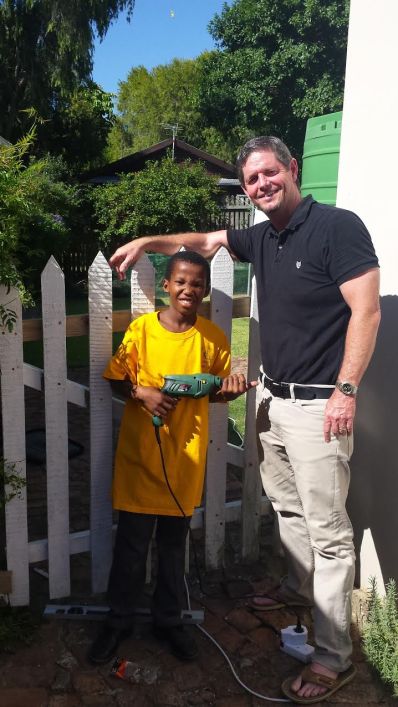
Kurt teaching Siya how to repair a fence (2015)

This has led Siya to become a follower.  Looking to other boys (who too, have no guidance), for “like-mindedness” and acceptance.  Never a good scenario.  And for Siya, it led him down a path of poor choices.  Actions that got him expelled from the township primary school mid-year last year (2017). 

You may be wondering why a 14-year old boy is in primary school?  Well, actually, Siya just turned 14 in December.  So for 2017, he was a 13-year old boy in Grade 5.  He missed a couple of years of school while being shuffled back and forth between his parents.  

In South Africa, the school year runs from January – December.  Grade R – Grade 7 are in the primary school and Grade 8 – Grade 12 are in the high school.  Unlike the U.S., the South African government system is set up so that you cannot skip a grade.  It does not matter if you are more advanced than the grade you are in… you cannot test up.  Every student must complete every grade.  So in Siya’s case, since he missed a couple of years, the schools would not even test him to see if he could be placed in a higher grade with peers his age.  

Here is Siya’s story…

Up until the age of 5 years, Siya’s father was in his life.  He was and still is a police officer in the Eastern Cape (a 3-hour drive from Knysna).  A man with a good job, but not a good man to his wife and children.  In the past, Siya was witness to his dad’s violence toward his mother and older sister.

A few years after his parents separated, Siya’s mom became very ill.  While she was in the hospital, he and his sister Zanele were sent back to live with their dad.  Siya was about 10-years old at this time. 

When their mother returned home from the hospital, she was confined to a wheelchair.  It was decided that since Siya’s dad was working, he and his girlfriend could better care for the two younger children. 

Now out of work and no way to pay rent, Siya’s mom decided to move to Knysna to live in the home of a relative.  She took her oldest daughter and her young niece, but left Siyabonga and Zanele behind.  This was a mistake.

Once their mother was no longer living in the Eastern Cape keeping tabs on her children, their father moved them out of his home and into the shack of another one of his girlfriends.  This woman was not pleased, but obeyed her boyfriend.   She allowed them to live under her roof, but she did not care for them.   Out of spite, the only food she would give them was usually old and moldy.   As if this wasn’t bad enough for Siya and Zanele, things got worse when their dad stopped visiting them and stopped sending money to this woman.  She didn’t kick them out, but she refused to feed them anything.   At 11-years old, Siya was left to beg for food on the streets and eat out of garbage bins.  He and Zanele were starving.  

Siya’s older sister got word of this through friends and relatives and saved up money to travel to Port Elizabeth (P.E.). to bring her siblings to Knysna.  When she arrived, her father refused to let the kids leave.  Not expecting this response, and fearing her father’s violence, she had to come up with a way to sneak them out of town.  This is when “Operation Sibling Rescue” hatched.  (At least that is what I am calling it!)

She told the kids to pack a few things and go to school like normal.  Then she told her father she was going to return to Knysna.  This was true, just not the whole truth.  She secretly went to their schools, got the kids and their transfer records, got in a taxi, and brought them to Knysna to live with their mom.

This is where I am supposed to say… And they lived happily ever after.  But I can’t.  As time went on, Siya’s dad stopped contacting him and sending money for child support. The young boy’s behavior started to decline.  He started lying and skipping school.   He was hurt, lost and broken.  He wanted his dad to love him.  To want him.  To be with him.  He begged to go back to P.E.  Siya did not remember just how poorly his dad treated him.  Or at least he did not want to remember.  He just wanted his dad.

And so it was.  He moved back to P.E. to live with his dad.  Within 6 months, Siya was crying to come back to Knysna.  His mother made him finish the year with his dad and then sent his sister back to P.E. to get him.  She was shocked at what she found.  A “street kid”.  Dirty, hungry, unschooled, unsupervised.  Really.  A street kid.  Nobody had been caring for him.  A 12-year old boy left all on his own.  Inexcusable!  Heartbreaking.

She scooped him up and brought him back to Knysna.  For months he was not allowed back in school because his father would not send his school transfer papers.  

Once he was enrolled, he was put into grade 4 as a 12-year old.  This was not a great situation, as he was so much older than many of the other children.  But it was how the system works.  The following year as a 13-year old in grade 5, Siya got mixed up with some other boys making poor decisions.  He was caught with dagga (pot) on the primary school campus… not once, but twice.  The second time got him expelled, and he was not allowed to finish Grade 5.

That brings us to where Siya is today.  Since he was expelled from the township school last June, he was not in school when the new year started up again in January.  And although the township school finally agreed to re-admit him this year, there wasn’t room.  He was turned away.  Denied an education at the age of 14!

That left 2 options.  (1) Let Siya become a young man that will never have anything higher than a Grade 4 education and chance losing him to “The Streets”.  Or (2) Search for a private school in town that will take him.

Option 2 was the only option we were willing to take!  After visiting a few schools, Kurt and I found a Christian School willing to accept him. This very small school groups children by age instead of grade.  Siya is in a class of 14-18 year olds (Instead of a Grade 5 classroom).  All of the students work on their own, at their own level.  A facilitator/teacher works with them one-on-one.  He just completed his first week and seems to be very happy there. 

unnamed-3
Kurt and I picked Siyabonga up for his first day of school. (Feb. 12, 2018)

With the generous donation from a couple in the United States, Siya’s monthly tuition and transport to school have been covered. 

This is Siya’s last chance. 

This young boy, that we have grown to love as family, will have no other chances after this one, when it comes to his education.  We are pulling for him.  We are praying for him.  We are loving on him.  With such a short time to impact his life each year, we pray that we can plant seeds that will carry him through until we return again next January.

We pray that he will embrace this opportunity and excel into the young man God has created him to be.  ~Tracy Cooper